Jumping Out Of An Airplane
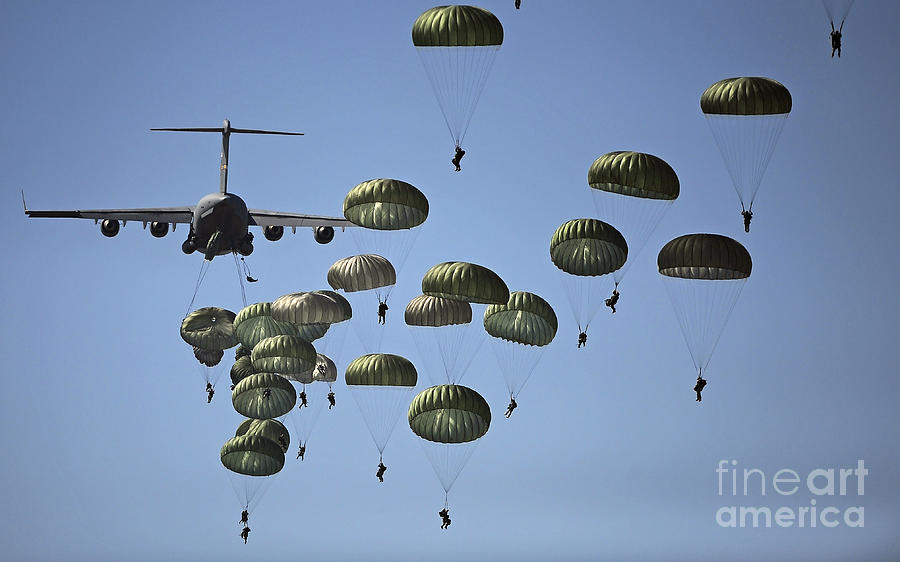
To become airborne, soldiers must attend the US Army Airborne School, which is also at Fort Benning, Georgia. This physically demanding three week course trains soldiers to conduct military parachute operations. During the final week of the course, cadets conduct five parachute jumps as a prerequisite to graduation. Cadets who graduate are awarded the U.S. Army Parachutist Badge. Airborne qualification is a prerequisite for assignment to Airborne units such as the 82nd Airborne and the Rangers.
The main purpose of being airborne is the ability to be deployed into combat zones without a land passage, as long as the airspace is accessible. Formations of airborne forces are limited only by the number and size of their transport aircraft; a sizeable force can appear "out of the sky" behind enemy lines in merely hours if not minutes. Airborne operations have a place in large-scale combat operations. They allow commanders to be bold and audacious and gain an advantage against an adversary.
Navy Seals have heroes too!
What Army Rangers Specialize in.
Special Operations Raids- One of the defining answers to “What do Army Rangers do?” is their expertise in conducting special operations raids. These lightning-fast missions aim to seize enemy resources, destroy critical infrastructure, or capture high-value individuals before disappearing into the shadows. Surprise forms the cornerstone of their strategy to ensure minimal casualties and mission success.
Forcible Entry Operations- Another key aspect of “What do Army Rangers do?” involves mastering forcible entry operations. These highly specialized operations typically center around seizing control of key infrastructure, with airfields representing prime targets.
Special Reconnaissance: Behind Enemy Lines- Special survey is a cornerstone for understanding what army rangers do in the modern battlefield. These stealth missions involve venturing deep behind enemy lines and gathering vital intelligence that guides strategic decision-making at the highest levels. These missions require Rangers to complete a 12-mile ruck march with equipment and weapons, and land navigation skills are essential. But it’s not simply about observation: Rangers conduct these operations in highly hostile environments, often relying on camouflage and specialized training to avoid detection. The success of future missions depends heavily on their ability to remain undetected.
RANGERS LEAD THE WAY!!